FDA VS EU Food Labeling: What FMCG Brands Must Know in 2026





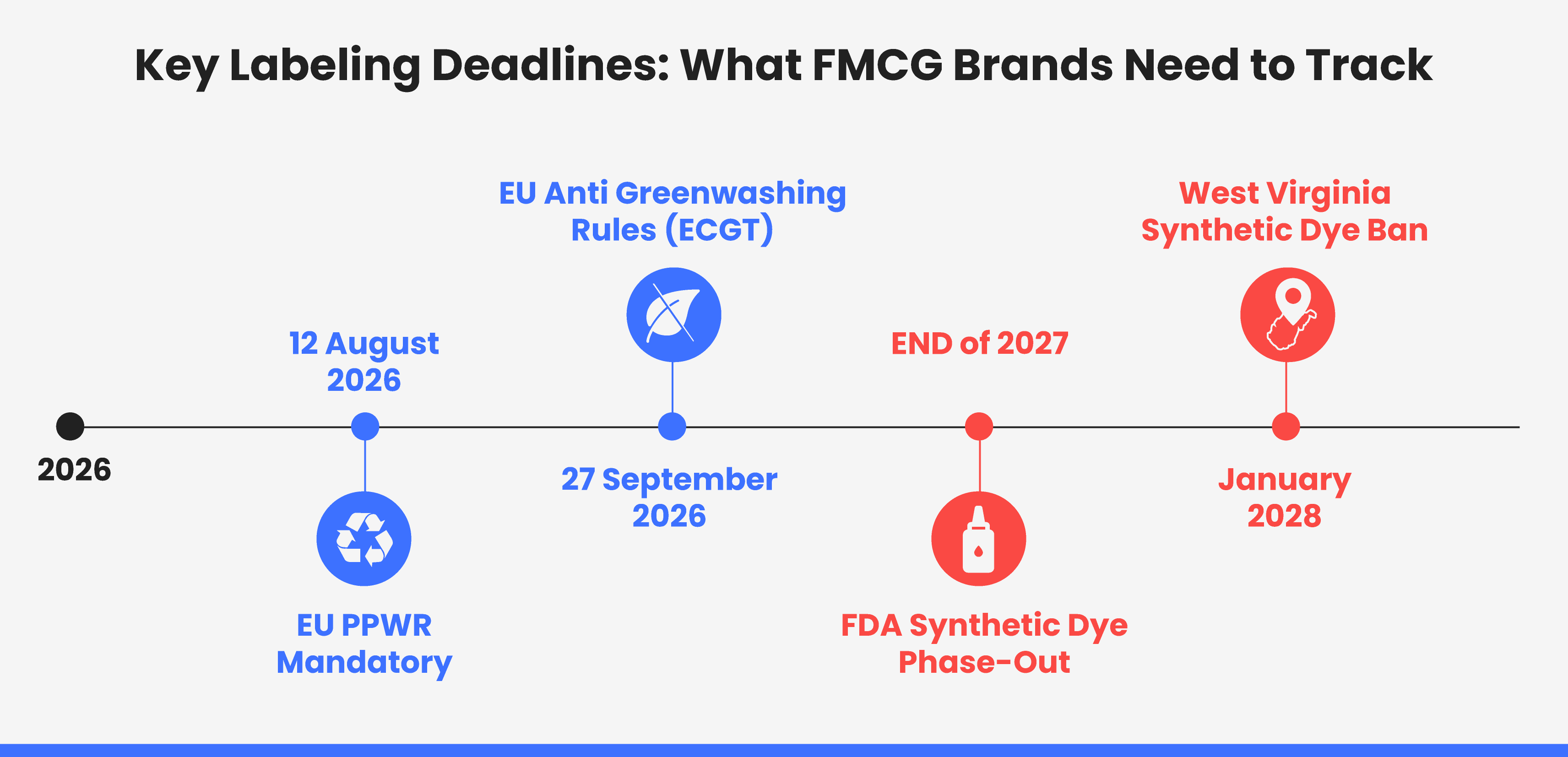
If you're selling packaged food in both the US and the EU, 2026 is not a quiet year. The EU's new packaging regulation kicks in August. Anti-greenwashing rules follow in September. On the US side, the FDA is phasing out six synthetic dyes and states are writing their own rules faster than brands can track them. Two markets, four major changes, one year. Here's what your label and artwork teams need to know.
The FDA and EU don't just have different rules. They have different jobs.
The FDA's mandate is nutritional accuracy: is what's on the label true, and can consumers make informed choices based on it? The FDA is prescriptive and ingredient-focused. Rules get updated when science shifts or a public health issue reaches critical mass. The system is largely reactive.
The EU's mandate is broader: is the product, its packaging, and every claim on it defensible, environmentally and legally? The EU operates on a different premise entirely. The EU treats packaging as a policy tool. That's why compliance in Brussels feels more expansive than compliance in Washington.
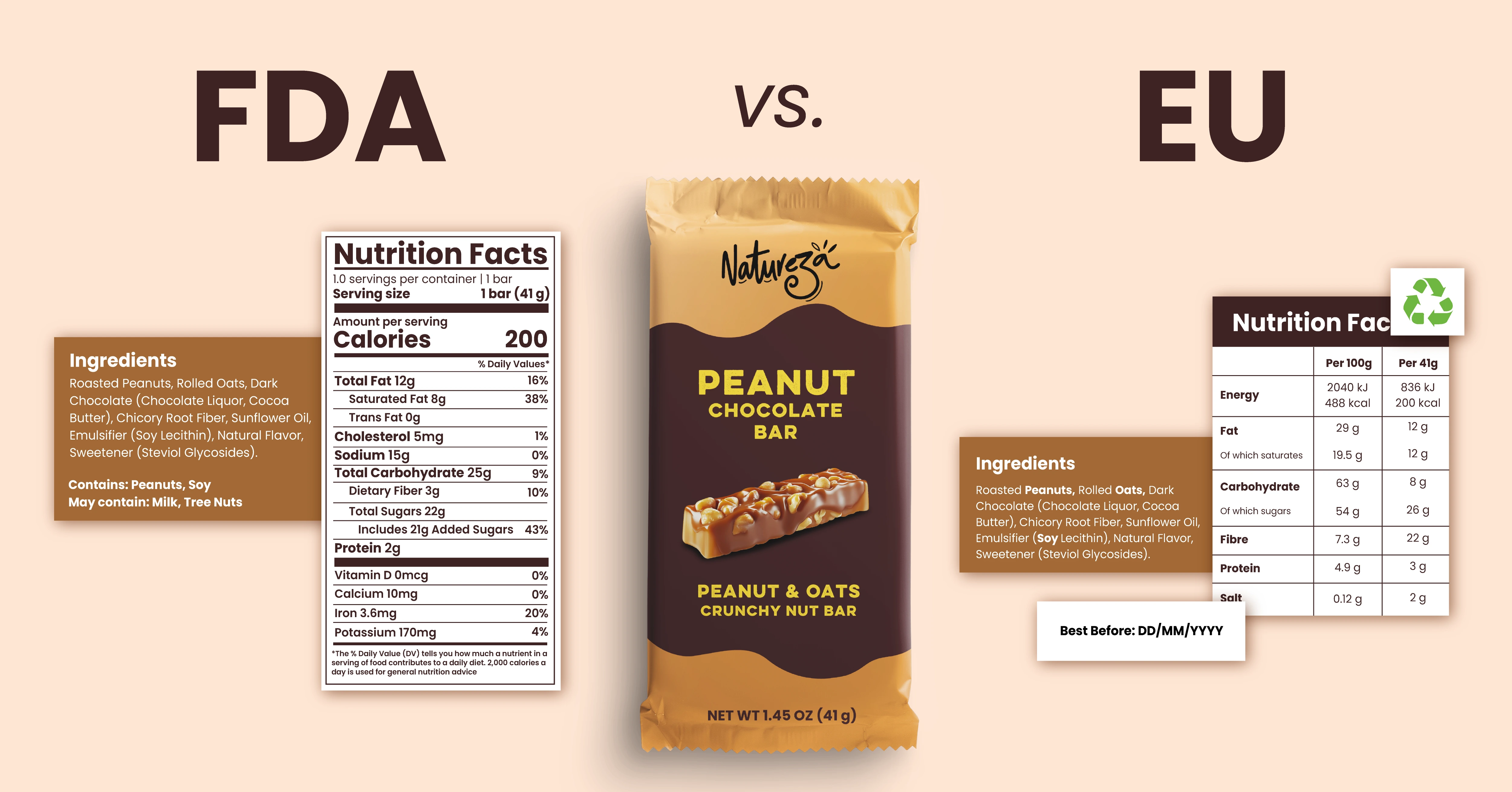
Both markets require the same core elements on pack, but how each is presented differs in ways that matter for cross-market label management.
In 2026, both markets are changing simultaneously, and the deadlines are closer than most teams realize.
In April 2025, the FDA announced a plan to eliminate six petroleum-based synthetic dyes Red 40, Yellow 5, Yellow 6, Blue 1, Blue 2, and Green 3 from the food supply, with the working timeline now set for end of 2027. The phase-out is voluntary at the federal level, not a binding rule — but the industry isn't waiting. The FDA is maintaining a public tracker of manufacturer's pledges, and several of the largest US food companies have already committed to completing reformulations by that deadline. If your products contain any of these dyes, your ingredient statement and color-related claims will need updating. Plan label artwork revisions now, not when reformulation is complete.
The FDA also issued enforcement discretion guidance allowing companies to use "no artificial colors" claims during the transition period, even before full reformulation is done, provided no FD&C-certified dyes remain in the product. That's a meaningful label claim opportunity, but it comes with its own substantiation requirements.
Texas and West Virginia both enacted food additive labeling laws in 2025. Key details your team should know:
If your distribution spans multiple US states, you may already need market-specific label versions.
Still a proposed rule, not finalized. The FDA is analyzing public comments and preparing options for leadership in 2026. If finalized, compliance timelines would be three to four years from the effective date. It's not an immediate action item, but brands redesigning packaging now should pre-engineer front panel real estate for it.
The Packaging and Packaging Waste Regulation (Regulation EU 2025/40) becomes legally binding across all 27 member states on 12 August 2026. For label and artwork teams, two things need to be on pack before that date: harmonized recyclability labels telling consumers which bin the packaging belongs in, and material composition pictograms. The Commission is still finalizing the exact pictogram formats, but the August deadline is fixed. After that date, non-compliant packaging cannot enter the EU market.
Later phases follow. QR code identifiers become mandatory from 2027, and full harmonized EU labeling from August 2028. But those timelines don't soften the first deadline. If your EU artwork hasn't been revised yet, August 2026 is the date to work back from.
The EU's Directive on Empowering Consumers for the Green Transition (ECGT) takes effect on 27 September 2026. It bans generic environmental claims unless they are specifically substantiated with verifiable data. Practically, this means:
Any such language currently on your EU packaging needs a compliance audit before September.
Already prohibited from 12 August 2026 under the PPWR. If your packaging uses coatings, inks, or adhesives that contain PFAS, this isn't just a labeling change. It's a material change, and it may trigger a label revision if your compliance documentation references those materials.
The US mandates declaration of eight major allergens. The EU mandates 14, adding molluscs, lupin, sulphites, and others. But the more common error isn't the count. It's the format. The EU requires allergens to be visually distinct within the ingredients list, typically bold or italics. The FDA allows a separate "Contains" statement below the ingredients. Brands copying a US label for EU markets frequently miss this distinction, and it's one of the most common compliance errors in cross-market launches.
In the US, sustainability language on packaging is largely voluntary and lightly regulated. In the EU from September 2026, it is legally scrutinized. A claim that packaging is "recyclable" must mean it is actually recyclable in the local collection infrastructure, not just technically recyclable in theory. "Made from sustainable materials" without certification is banned. What's acceptable on your US label may constitute a prohibited claim on your EU version of the same product.
Managing labels across the US and EU in 2026 isn't a one-time compliance project, it's an ongoing operational discipline. Each market now has its own regulatory timeline. A change triggered by the US synthetic dye phase-out shouldn't automatically touch your EU artwork. A PPWR update to EU recyclability icons shouldn't contaminate your US master file. That separation only holds if your artwork workflow manages each market's label as a discrete, versioned document with its own compliance status and approval history.
The brands that handle this well don't just have a compliance team, they have a system. When a regulatory change lands, they know exactly which SKUs are affected, which markets, and which label elements need to change. They can move from regulatory update to approved revised artwork without the process of creating downstream errors.
Before your next packaging run, your team should be able to answer yes to all of these:
Staying compliant across two markets is not easy. ManageArtworks helps packaging and compliance teams do exactly that. See how it works.

The core difference is philosophical. The FDA focuses on nutritional accuracy and ingredient transparency. The EU extends labeling responsibility to packaging sustainability, recyclability, and the substantiation of environmental claims. In practice, this means an EU-compliant label requires significantly more than its US equivalent, particularly from 2026 onward.
No. If you're selling in the EU, your product must comply with EU regulations regardless of where it's manufactured. FDA compliance alone is not sufficient for EU market entry. Brands selling in both markets typically maintain two separate label versions per SKU.
Each market's label should be treated as a discrete, versioned document with its own compliance status and approval history. When a regulatory change affects one market, it should trigger a review of that market's labels only, without affecting the other. This requires a structured artwork management workflow, not just a shared folder system.

.webp)