Can't find what you're looking for?
Tell us what you need — our team is ready to give you the right solution.

Packaging Content for Amazon and Flipkart Listings in India

Packaging Content for Amazon and Flipkart Listings in India

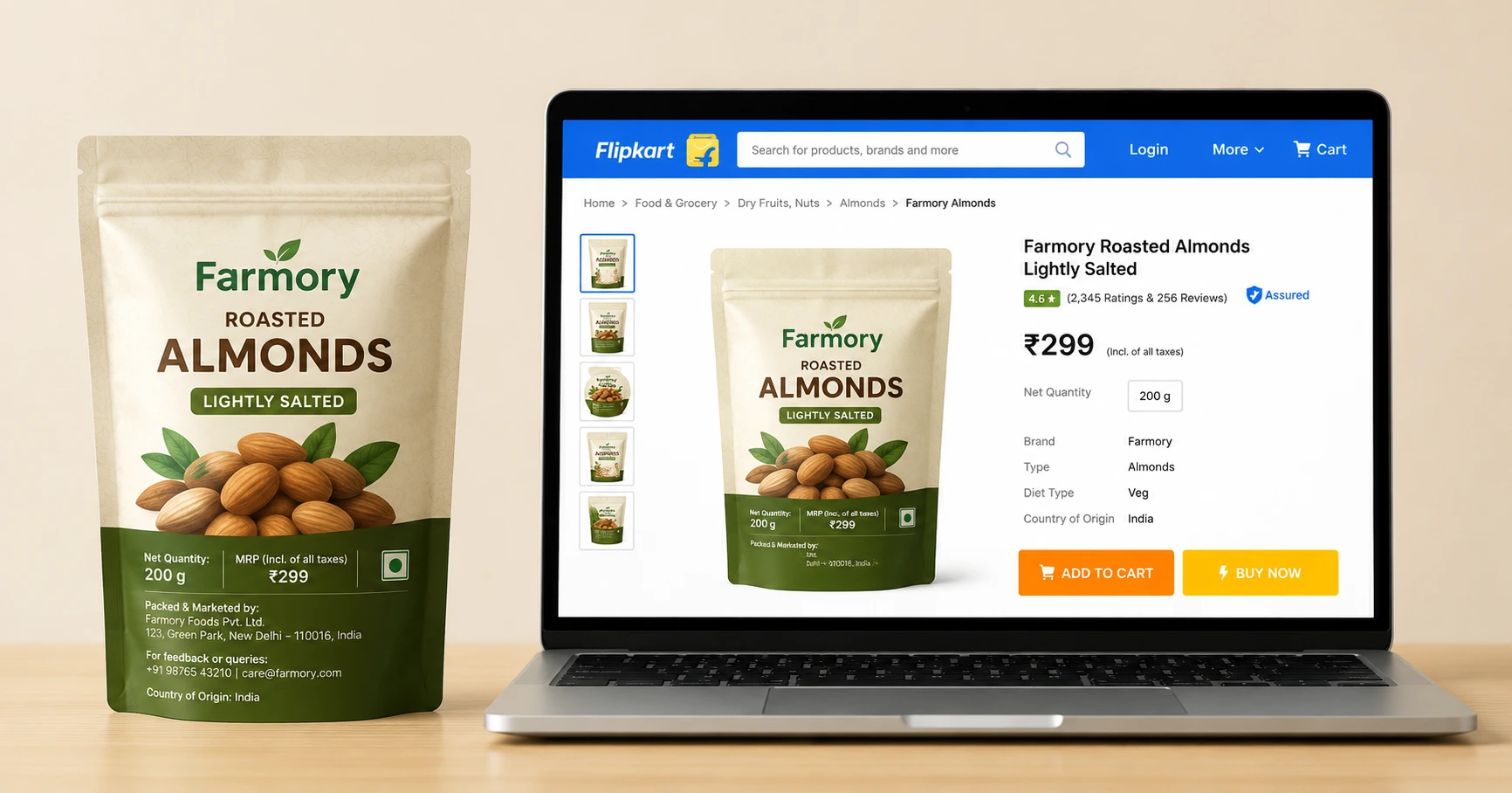
Selling on Amazon or Flipkart in India means managing two versions of your product content at once: what's printed on the pack, and what's shown on the listing. Both have to be accurate. Both have to match each other. When they don't, that's usually when listings get suppressed,  not because the product is wrong, but because the pack and the listing disagree.

This blog covers what's mandatory on the pack under Indian law, what each marketplace checks on top of that, why pack and listing content drift apart in real operations, and a checklist you can run every time artwork changes.

What packaging information is mandatory for Amazon and Flipkart in India?

Every pre-packaged product sold in India — online or offline — must carry certain declarations under the Legal Metrology (Packaged Commodities) Rules, 2011. Amazon and Flipkart both enforce these rules before a listing goes live, and both will suspend a listing that doesn't match.

At minimum, your pack needs:

Declaration What it means
MRP Maximum retail price, inclusive of all taxes
Net Quantity In standard grams, ml, or count, not a range
Manufacturer or importer details Name and address of the legally responsible entity
Month and year of manufacture/import The production or import date
Consumer care details A working phone number or email
Country of origin Mandatory on both pack and the listing since 2020


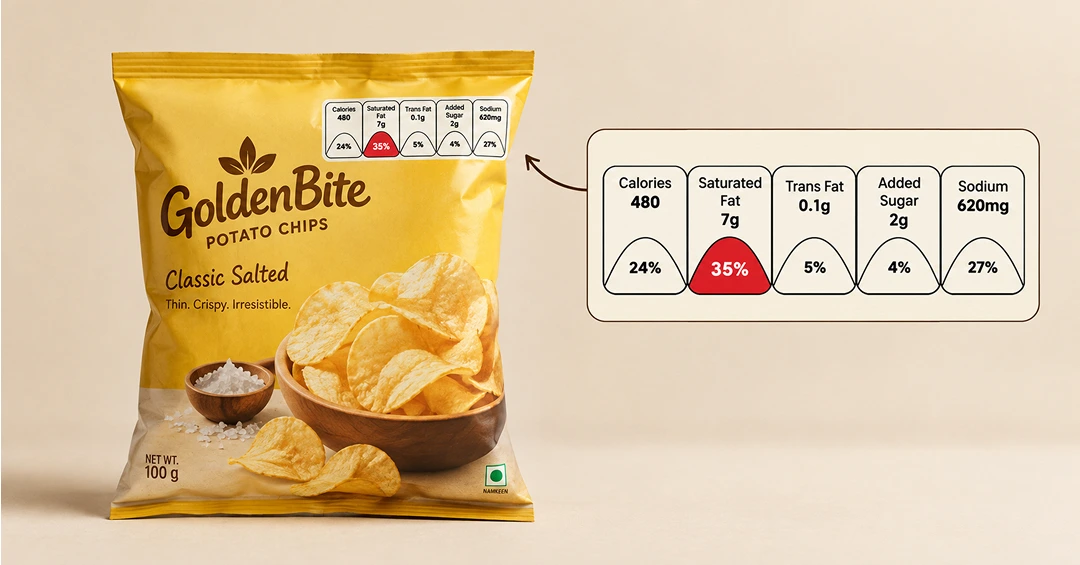
Some categories carry extra requirements like FSSAI licence numbers for food products, BIS certification for electricals, toys, and packaged drinking water, and AYUSH or CDSCO approvals for wellness and pharma-adjacent products. A missing or mismatched licence number is one of the most common reasons a listing gets stuck at approval.

Why do Amazon and Flipkart listings get suspended?

Most suspensions aren't caused by not knowing the rules. They're caused by the pack and the listing saying two different things. A pack with a revised MRP of ₹229 while the listing still shows ₹199 is a mismatch, even if both values were correct at some point. The same issue can arise when net quantity, license numbers, or country-of-origin details change. The fix isn't more compliance knowledge. It's a process that checks both sides every time the pack changes.

How pack declarations affect listings

Each of the declarations above exists for a reason, and each one has a digital equivalent somewhere in your listing:

  • MRP: must match the price shown or referenced on the listing, including after any price revision.
  • Net quantity: must match the title, bullet points, and backend attribute on the listing, not just the pack.
  • Manufacturer/importer address: needs to be consistent across pack, listing, and any brand registry documentation.
  • Country of origin: has to appear both on the physical pack and as a listing attribute; a mismatch here is a common suspension trigger.
  • FSSAI/BIS/AYUSH/CDSCO numbers: need to match the licence number on file with the marketplace, not just be present on the pack.

If any of this change during a pack redesign, the listing needs a matching update. That update is the step most teams miss.

Amazon-specific listing requirements

Amazon's checks are largely automated. That means a listing can get flagged or suspended without a human reviewing it first, so catching problems before submission matters more than catching them after.

Common reasons listings get suppressed on Amazon:

  • Image issues: no pure white background on the primary image, watermarks or promotional text overlaid on the product shot, low resolution
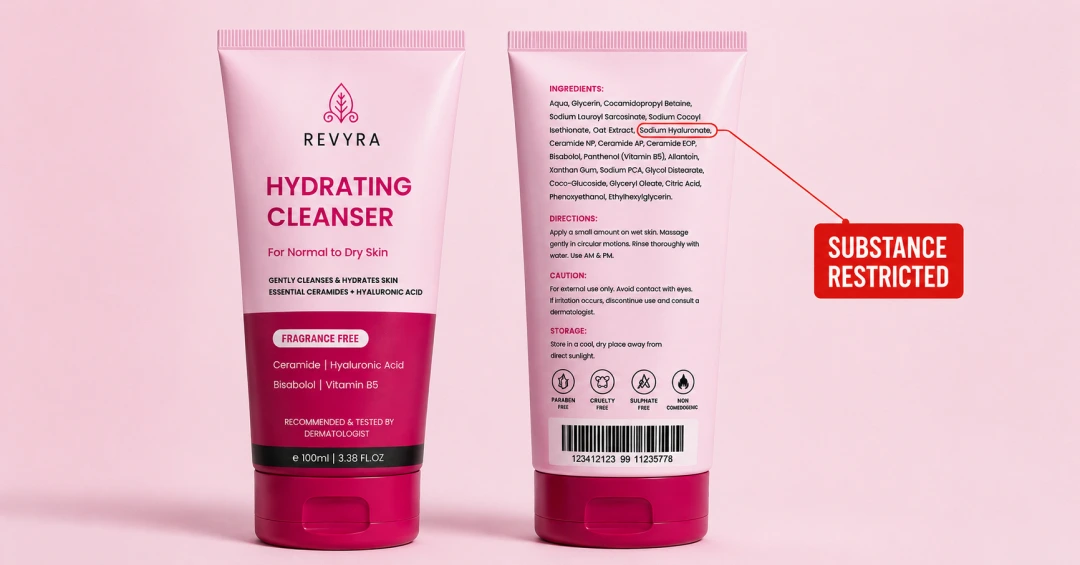
  • Prohibited claims: words like "best," "guaranteed," or unverified health claims, especially in food, health, and personal care categories
  • Missing category attributes: size charts for apparel, ingredient lists for food, safety information for toys and electricals
  • Data mismatches: net quantity, MRP, or country of origin that doesn't match between the listing title, backend attributes, and the pack

Flipkart-specific requirements and approval process

Flipkart's process works differently. Instead of publishing first and checking after, many categories require approval before a listing can go live at all.

Key differences from Amazon:

  • GST and brand documentation are often required upfront, before submission, for certain categories
  • Category-specific approval gates apply to categories like electronics and F-Assured-eligible products, requiring manual review of seller-level documents, not just product content
  • Less automated flagging, more upfront gating — Flipkart tends to block a listing from going live rather than suspending it after the fact

A compliance process built only around Amazon's automated checks will miss the categories where Flipkart blocks listings at submission. Treat these as two different systems, not one.

Why pack content and listing content fall out of sync

This is where most compliance issues actually start. A few common causes:

  • MRP revision: pack updates to a new MRP, but the listing's price logic or displayed MRP isn't updated at the same time
  • Net quantity change: pack size changes (500g to 480g), but the listing title, bullets, and backend attribute aren't all updated together
  • FSSAI or licence number update: a renewed or revised licence number appears on the new pack but isn't updated in the marketplace's compliance documentation
  • Country of origin change: manufacturing moves to a new location, and the pack reflects it, but the listing's COO field is never updated
  • New or dropped claims: pack adds "no added sugar" or drops a claim, but listing copy still reflects the old version, risking a prohibited-claims flag
  • Regional-language declarations: mandatory text in a regional language exists only on the physical pack and was never logged anywhere in the digital record

None of these happen because a team doesn't know the rules. They happen because updating the pack and updating the listing are two separate tasks, done by two separate people, with no shared trigger connecting them.

One way to avoid these disconnects is to manage packaging copy and e-commerce content from the same source instead of maintaining separate spreadsheets, documents, and marketplace templates. Platforms like ManageArtworks let teams store approved pack copy, translations, and e-commerce content together in a single repository. When packaging content changes, everyone works from the same approved information, making it easier to update marketplace listings alongside the artwork instead of treating them as separate activities.

Pack-to-listing sync checklist (visual-style)

Run this check every time artwork changes, for any reason, on any SKU:

  • Net quantity: does the listing title, bullet copy, and backend attribute match the new pack?
  • MRP: is the listed price and any tax-inclusive display updated to match the revised pack?
  • FSSAI/BIS/other licence numbers: does the number on the new pack match what's on file with the marketplace?
  • Country of origin: does the digital COO field match the new pack, especially after a manufacturing location change?
  • Pack size or dimensions: has this changed shipping weight, package type, or any size-based attribute?
  • Claims language: did the new pack add or remove a claim that the listing copy needs to reflect?
  • Regional-language declarations: is any pack-only regional-language text now documented in the digital record?

Building an artwork-to-listing workflow

A checklist only works if someone is triggered to run it. Four things make that happen reliably:

  1. Named ownership. One person should be responsible for updating the listing whenever artwork changes.
  2. A trigger built into the artwork process. When a pack revision is approved, the listing team should be notified automatically. Don't rely on someone remembering to mention it separately.  
  3. Version control across both records. Version-control the pairing between a pack version and a listing state, not just the artwork file. That pairing is what lets you check, later, whether the live listing actually matches the pack currently shipping.
  4. A defined handoff point between teams. Packaging, regulatory, and e-commerce teams each own part of the process. Make sure every handoff has a clear owner and a review step.

At a small SKU count, one person can eyeball every pack against every listing. Past a few hundred SKUs across multiple sizes, regions, and marketplaces; that stops being possible. Without a formal process, keeping packs and listings aligned becomes increasingly difficult.

How can sellers avoid compliance issues going forward?

Start by identifying where pack content and listing content are managed today, and who is responsible for each. If those updates happen in different systems and depend on someone remembering to inform the next team, that's where the problem usually begins.

Packaging changes rarely happen in isolation. A revised MRP, a new FSSAI license number, or a change in pack size often affects marketplace listings, shipping attributes, and compliance records at the same time. The more products and marketplaces you manage, the more important it becomes to connect those updates instead of handling them separately.

Frequently Asked Questions

What packaging information is mandatory for products sold online in India?
Know More

Pre-packaged products generally need declarations such as MRP, net quantity, manufacturer/importer details, date of manufacture or import, consumer care details, and country of origin, along with category-specific requirements where applicable.

What happens if my product packaging and listing information don't match?
Know More

A mismatch can lead to listing approval issues, suppression, requests for documentation, or other marketplace compliance actions, depending on the product category and the nature of the discrepancy.

Can a packaging change affect an Amazon or Flipkart listing?
Know More

Yes. Changes to MRP, pack size, claims, license numbers, manufacturer details, or country of origin may require corresponding updates to marketplace content and attributes.

Recent Blogs

Ready to see how ManageArtworks
Could work for you?

Correct
Free for 14 Days
Correct
No card details required

Hear what Our Customers say

Cedar's company logo with an image of a green cedar tree.
We wanted to streamline our label approval process with a functional program that could help us avoid human error, consolidate information, store assets, and provide timelines. ManageArtworks met all of these needs and is extremely user friendly, so our adoption to the software was seamless. The customer service and customization far exceed expectations.
Icon of a stylized helmet with face guard in turquoise and the word HEALTH next to it.
The system's efficiency in handling artwork submissions, revisions, and approvals has not only saved us valuable time but has also enhanced collaboration among team members. Its automated notification feature has greatly reduced communication gaps and improved overall project coordination. the Artwork Management System has been a game-changer for us. Its reliability, ease of use, and comprehensive capabilities make it an indispensable tool for anyone dealing with artwork management.
Borosil brand logo
ManageArtworks has significantly improved our workflows and artwork development process. The tool makes it easy to initiate new projects and set up timelines for artwork development. The ability to store all relevant information in one central location has been a game-changer as it allows us team members to collaborate and communicate seamlessly. Special thanks to the customer support team for their responsiveness and meaningful support.
Chegg logo featuring a stylized open book with blue and green pages and an orange bookmark.
ManageArtworks is an excellent product to work on with. With this tool, our artwork development timelines are coming down and efficiency is getting improved. This tool makes it easy for multiple departments to work together seamlessly. My special appreciation to the support team. They are extremely knowledgeable, listen to all the queries carefully, and come up with solutions quickly. They ensure that the new updates are implemented without disrupting our work.
DrReddys logo with stylized purple text and a heart-shaped design composed of leaf elements.
What sets ManageArtworks apart from off-the-shelf document management systems (DMS), artwork management systems and other collaboration platforms in the market is the fact that it is an integrated solution that brings together DMS, workflows, record management (packaging records & batch records), advanced reporting, analytics and audit trails. Everyone at ManageArtworks from the leadership to the project manager, were willing and able to configure the solution as per our specific needs.
Parle Agro
We are in an FMCG Volume Business where end-to-end artwork ecosystem and quick turnaround time are critical elements. We wanted to digitalize the Artwork Management to eliminate human errors and improve turnaround time. At Parle Agro Ltd, we achieved these objectives with the implementation of the KAROMI ManageArtworks System. The KAROMI project and support team, along with senior management, have proven to be exceptionally supportive, knowledgeable, innovative, and committed throughout the journey.
Parle Agro
We needed a solution to manage our artwork development and approval process better, and found ManageArtworks. With this easy-to-use system, we have been able to effectively reduce time to market, increase productivity, and increase artwork review disciplines to help minimize errors.
Parle Agro
After a year of development, we adopted ManageArtworks for proofreading and validation. Following a trial in the French market, we expanded its use to subsidiaries and export.
This 100% English platform was quickly mastered by internal and external collaborators. It offers centralization, data security, traceability, and streamlined packaging reviews, saving time and effort. After 3+ years, it continues to receive unanimous praise and a growing user base!